العربية




Quick Answer
Sintered stone is familiar as a flat countertop or wall panel. A rounded reception desk, wrapped column or shaped basin asks the surface to do something different: follow a change in direction.
Can sintered stone do that? Yes—suitable products can be formed into curves through specialist hot-bending processes. But first, identify what “curved” means in the design. A circular tabletop and a panel wrapping around a desk may both be described as curved stone, although their shapes are made differently.
Contents
Yes, but a curved outline and a curved surface are different things. Cutting can give a flat slab a rounded outline; hot bending changes the direction of the surface itself.
Imagine a circular tabletop cut from a flat slab. Its outside edge follows a circle, but the top remains flat. Cutting creates the rounded outline.
Now imagine the front of a reception desk sweeping around towards its sides. Here, the face itself changes direction. A shaped panel follows that curve.
Hot bending, also called heat bending, is one way to produce this second type of shape. Suitable material is heated under controlled conditions, formed using a mould or shaping tool, and cooled to retain the required profile. The finished piece has an established shape; it is not a flexible sheet that installers can freely bend on site.
This allows a curved section to carry the surface through a turn that might otherwise be assembled from separate flat pieces. The available shapes and finishes depend on the particular material and forming process. Natural marble gets its curves differently, by cutting or joining the stone: see how curved marble panels are made.
The useful question is not just which room contains the material, but which part of the design is curved.
Around a column, shaped panels provide the decorative covering. The column remains the underlying structure; the panels follow its outside profile.
A complete covering may contain several curved sections. Their arrangement determines where the joints fall around the column and along its height.
Wall applications include rounded outside corners, concave recesses and broader curved features. A corner piece can connect two flat wall areas, while a sweeping wall needs a larger arrangement of panels. In both cases, the supporting and fixing system is part of the installation design.
A reception desk can combine a flat horizontal worktop with a curved vertical front. That front may sweep towards both sides, with other panels completing the desk.
When looking at a reference image, ask:
These questions identify different parts of the design. A rounded top does not necessarily require hot bending, while a curved front involves a shaped facing.
The same distinction applies to bars and kitchen islands. Naming the top, front, side or corner makes the intended effect clearer than describing the whole item as a “curved countertop.”
A basin shows the difference at close range. The flat countertop approaches the washing area, then the surface turns down into the bowl.
The photograph below shows this transition on one of our hot-bent sintered stone basins. Follow the grey pattern from the flat area towards the bowl: the surface changes direction along the rounded perimeter.
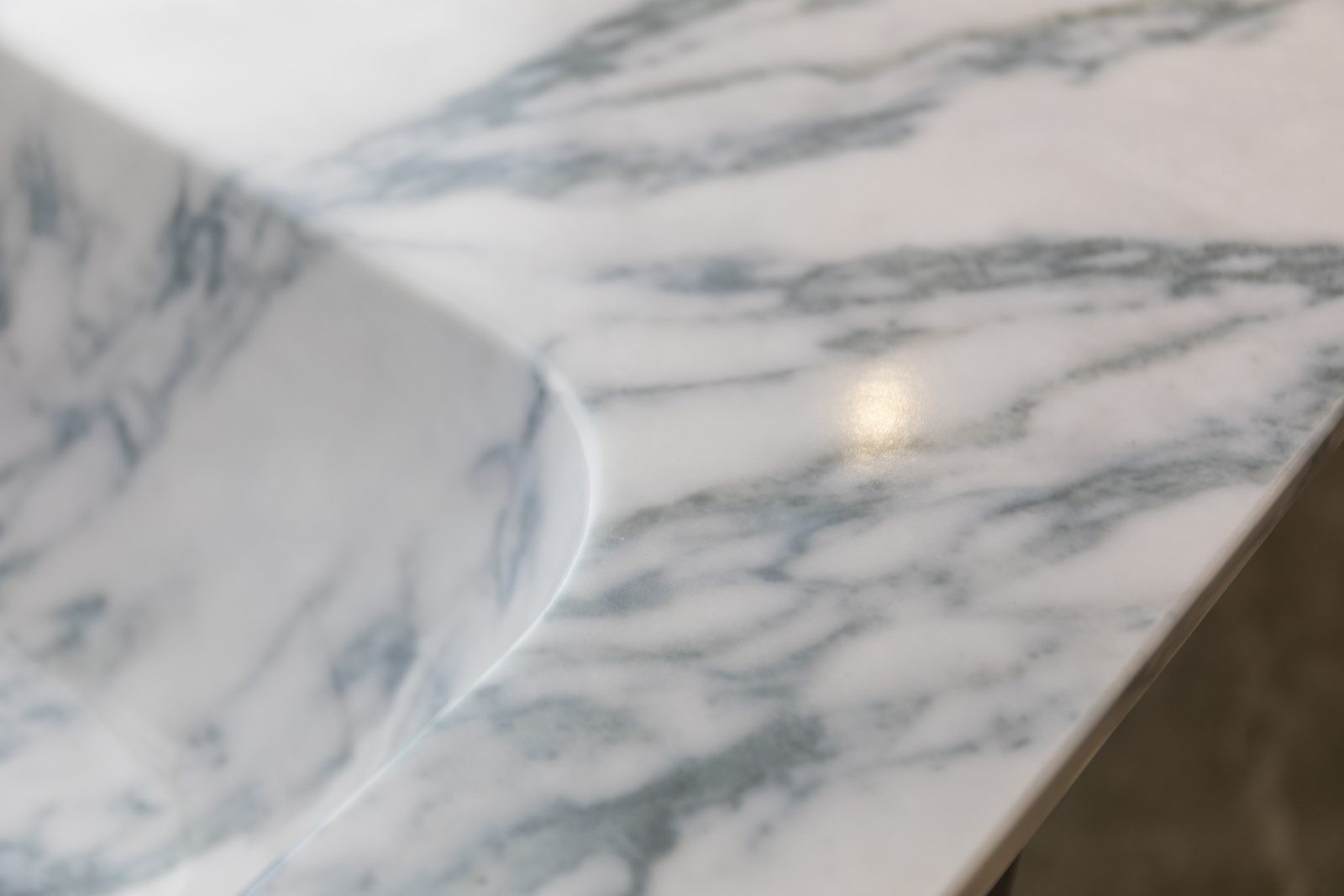
This is a more useful detail to examine than the basin’s rectangular outside outline. It shows where forming contributes to the finished shape.
Industry suppliers also offer shaped decorative pieces for arched openings, niche reveals and similar architectural details. As with wall and column cladding, these are specific facing components within a larger construction.
A curved piece and a complete installation are not necessarily the same thing.
Consider a rounded reception desk. One shaped panel may carry the front around a corner, avoiding a junction at that turn. The panel can still meet a flat worktop above and another panel at its end.
The corner is continuous; the whole desk is assembled.
A column covering works similarly. Each panel has a curved face, while its edges meet neighbouring panels. A visible joint between sections does not mean that the individual sections were not formed.
For our integrated basin, the continuous surface described on the product page is the countertop-to-bowl area shown in the photograph. That identifies a particular relationship between the top and bowl. It does not describe every connection in the surrounding vanity or its installation.
This is why “hot-bent,” “integrated” and “seamless” should be tied to the actual product. Hot-bent describes the forming method. Integrated describes how parts are combined. A claim of a seamless surface needs to identify the area being discussed.
When examining a design, look at where the curve starts, how far it continues and where it meets another part. These three observations help explain both the shape and the joints.
A curved front and flat side may fit together accurately yet look disconnected if their decorative patterns do not coordinate.
Imagine a strong marble-look vein approaching the edge of a desk front. If the adjoining side begins with a quiet white area, the shape continues but the pattern appears to stop.
Both pieces may have the same colour name. Stone-look slabs can contain different areas of veining, background tone and contrast. The positions selected for separate pieces determine which areas meet.
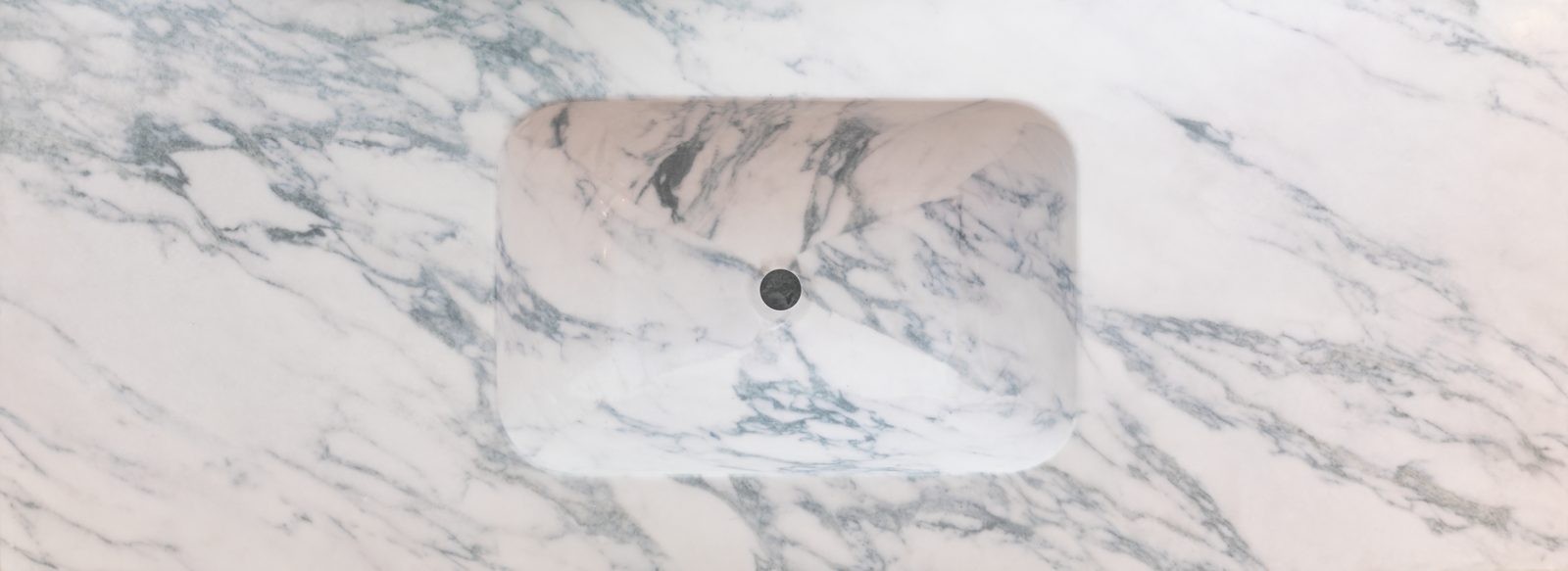
For this reason, choosing a colour and arranging its pattern are separate decisions. An overall slab image or proposed layout can show relationships that a small colour sample cannot.
Colour and gloss also matter where curved and flat parts sit together. A flat sample helps with initial selection; finished-piece photographs or an appropriate formed sample help establish the appearance of the curved product. Where close coordination is important, assess the proposed surfaces together.
Choosing a colour for a hot-bent basin? Ask us for a formed sample and look at it next to the flat material.
Yes. A curved piece costs more than the same sintered stone as a flat slab, because it has to be formed and finished to shape. How much more depends on the shape, the parts included and any matching requirements, so there is no dependable price multiplier for every design; compare quotations for the same specified parts and finish. For flat slab pricing, see our sintered stone price guide.
Some suppliers offer curved products for exterior applications. Suitability should be confirmed for the finished product, expected exposure and fixing system. The weather resistance of a flat slab alone does not establish the suitability of a complete exterior assembly. For flat sintered stone outside, see sintered stone outdoor kitchen countertops.
When contacting a supplier, mark the part of the reference image you want to preserve. On a desk, that might be the sweeping front rather than the rounded top. On a basin, it might be the transition into the bowl. If a particular vein connection is important, include it in the marked area.
This gives the discussion a clear starting point without requiring you to specify the factory process.
Excellent Stone supplies hot-bent sintered stone basins for bathroom projects.
Planning a basin? Send us a marked reference image or your drawings through the inquiry form or by email, and we can send a formed sample so you can see the colour and veining on the curve.
فئات
بلوق جديد
 ROOM 205,NO.45, MIDDLE HAIJING ROAD,XIAMEN,AREA OF PILOT FREE TRADE ZONE(FUJIAN)OF CHINA
for استفسارات حول منتجاتنا أو الأسعار بينها، يرجى ترك لنا وسنكون على اتصال في غضون 24 ساعات.



© حقوق النشر: 2026 XIAMEN EXCELLENT STONE CO.,LTD. كل الحقوق محفوظة.

دعم شبكة IPv6